“Full-stack” is a term marketing agencies borrowed from software development, where it originally meant an engineer comfortable working across the front end, back end, and everything connecting them. Applied to marketing, it promises the same thing: one team that handles strategy, SEO, paid media, content, web, and analytics under a single roof, so you’re not stitching together five vendors who barely talk to each other. It’s an appealing pitch, and for the right business at the right stage, it’s genuinely the smarter path. For others, it’s an expensive way to end up with mediocre execution across every channel instead of real strength in the one or two that actually move revenue.
This playbook is built to help you tell the difference before you sign a contract, not after. We’ll walk through what full-stack service actually includes, when it beats a specialized alternative, how to evaluate a provider honestly, and the specific questions that separate a genuinely integrated team from a generalist shop wearing a full-stack label. A useful place to start, before comparing any specific vendor, is understanding what a genuinely full-service provider looks like in practice. Boise-based SEO marketing Boise firm Bear Fox Marketing is one example of an agency built around exactly this integrated model, combining SEO, paid media, and web development under a single strategic umbrella rather than treating each as a separate transaction, which is the structural pattern worth understanding before you evaluate any provider against it.
What “Full-Stack” Actually Means in Digital Marketing
The term gets used loosely enough that it’s worth defining precisely before you evaluate anyone against it. A genuinely full-stack digital marketing provider offers integrated capability across strategy and positioning, search engine optimization, paid media across search and social, content creation, web design and development, email and lifecycle marketing, and analytics and reporting, all coordinated through a single point of accountability rather than handled by disconnected specialists reporting to different people.
The distinction that matters most isn’t the list of services. It’s the coordination between them. A complete rundown of what services a digital marketing agency should realistically offer is useful context here, because the difference between a full-stack agency and a loose bundle of services sold under one invoice comes down entirely to whether the SEO team is actually talking to the content team, whether paid media insights feed back into organic strategy, and whether your website’s conversion data shapes what gets prioritized next across every other channel. A provider that checks every box on a service list but runs each one in its own silo isn’t offering full-stack marketing. It’s offering a portfolio of disconnected vendors who happen to share a logo.
The Real Tradeoff: Integration Versus Depth
Here’s the tension that most agency selection content glosses over, and it’s worth being honest about it upfront. Recent industry benchmark research paints a genuinely uncomfortable picture for the full-stack pitch. According to 2026 marketing agency industry data compiled from Promethean Research and the RSW/US Agency Survey, agencies that expanded their service offerings grew faster in the past year, but earned below-average net margins doing it, while agencies that narrowed their service mix grew the fastest of all and posted the highest net margins in the entire dataset. That’s a meaningful signal for anyone evaluating a full-stack provider: broadening service lines is genuinely harder to execute profitably than the sales pitch implies, and margin pressure on the agency side has a way of eventually showing up as service quality pressure on the client side.
This doesn’t mean full-stack is a bad choice. It means the quality bar for evaluating one properly is higher than most buyers realize, because you’re betting on a team’s ability to genuinely execute at depth across multiple disciplines simultaneously, not just their willingness to sell you a broader package. The businesses that get real value from a full-stack relationship are the ones that vet coordination and depth specifically, not just service breadth, before signing anything.
When Full-Stack Genuinely Wins
Despite that caution, there are scenarios where a full-stack provider is clearly the better structural choice, and understanding which category you fall into matters more than any generic pros-and-cons list. Businesses without an internal marketing function benefit enormously from a single accountable partner, because coordinating five specialist vendors requires marketing management expertise that a business without any internal marketing staff simply doesn’t have yet. In that situation, the coordination overhead of managing multiple specialists internally would eat the savings a specialist model might otherwise provide.
Companies at an inflection point, launching a new brand, entering a new market, or undergoing a significant digital transformation, also benefit from full-stack coordination, because the channels genuinely need to move together during a launch in a way that’s hard to achieve when five separate vendors are each optimizing their own slice without full visibility into the others’ work. Businesses with a genuinely limited internal team and limited bandwidth to manage multiple vendor relationships are the clearest case: the value of one point of contact, one unified strategy document, and one team accountable for the whole customer journey outweighs whatever specialist depth they’d gain by splitting the work across separate providers.
When Specialization Wins Instead
The opposite case is just as real and deserves equal weight. A business that has already identified its primary growth channel, say, organic search is clearly where the highest-value customers come from, benefits more from a specialist who lives and breathes that discipline than from a generalist splitting attention across six channels simultaneously. Specialists tend to compress the learning curve dramatically, because they’ve solved your exact category of problem many times before, while a full-stack generalist team is more likely to be encountering some of your specific challenges for the first time within their broader scope.
Businesses with an existing internal marketing function also often do better pairing that internal team with specialist vendors for specific gaps, SEO, paid media, or content production, rather than replacing internal strategic ownership with an external full-stack relationship. In that structure, internal staff retain strategic control and brand context while specialists execute the technical depth that’s genuinely hard to build in-house at a small scale.
Comparing the Two Models Directly
The table below breaks down how full-stack and specialized models actually differ across the factors that matter most when making this decision.
| Factor | Full-Stack Agency | Specialized Agency |
|---|---|---|
| Typical monthly cost | $5,000 to $25,000+ | $2,500 to $10,000 per channel |
| Coordination overhead | Low, single point of contact | Higher, requires internal management |
| Channel depth | Variable, depends on team structure | Consistently deep in one discipline |
| Best for | No internal marketing team, launches, rebrands | Identified primary growth channel |
| Speed to strategic alignment | Fast, unified from day one | Slower, requires internal orchestration |
| Risk if team is thin | High, weak execution across many channels | Lower, risk contained to one discipline |
| Reporting complexity | Simpler, one unified report | More complex, multiple reports to reconcile |
Notice that neither column is objectively better. The right choice depends entirely on your internal capacity, how clearly you’ve already identified your priority channel, and how much coordination overhead you’re realistically prepared to manage yourself.
How to Evaluate a Full-Stack Provider Honestly
Given the margin pressure data above, evaluating a full-stack agency properly requires more scrutiny than checking whether they offer the services you need. The real question is whether they can execute at genuine depth across everything they’re claiming to cover, not whether the service list looks comprehensive on their website.
Start by asking who specifically will work on each discipline within your account, and how those individuals coordinate. A team with a dedicated SEO lead, a dedicated paid media strategist, and a dedicated content lead who meet regularly and share a unified reporting dashboard looks very different from one generalist account manager juggling six disciplines alone. Request examples of how insights actually moved between channels on a real client engagement, not hypothetically, but a specific instance where a paid media finding changed the SEO content calendar, or where website conversion data reshaped an email sequence. Agencies genuinely operating as an integrated team can answer this concretely and quickly. Agencies selling a bundled service list under a full-stack label tend to struggle with specifics here, because the coordination they’re describing doesn’t actually happen in practice.
Pricing and terms deserve equal scrutiny. Full-stack agencies command meaningfully more monthly spend than single-channel specialists, and understanding the difference between a fair coordination premium and simple padding, based on team size, seniority mix, and reporting depth, matters enormously here. The same due diligence that applies to evaluating a specialized provider like an influencer marketing agency against your specific budget applies with even more weight to a full-stack engagement, since you’re trusting one provider with a considerably larger share of both your budget and your overall marketing outcomes.
Red Flags Worth Watching For
A handful of specific warning signs show up consistently across full-stack engagements that underperform, and catching them during evaluation saves considerable wasted budget.
- Vague answers about team structure. If a sales conversation can’t tell you specifically who handles each discipline on your account, the “full-stack team” may be one or two generalists spreading themselves across everything.
- No examples of cross-channel insight sharing. An agency that can’t point to a concrete instance of one channel’s data informing another’s strategy likely isn’t actually running an integrated model, regardless of what the service list says.
- Reporting that’s just five separate reports stapled together. Genuine integration shows up in a unified dashboard connecting channels to shared business outcomes, not five disconnected platform-specific reports bundled into one PDF.
- Recent rapid service expansion with no corresponding staffing growth. An agency that added three new service lines in the last year without visibly growing its team is a real signal of the margin and quality pressure the benchmark data above describes directly.
- Pricing that seems too low for the stated scope. Full-stack execution at genuine depth costs real money to staff properly. A price significantly below market for comprehensive service across six disciplines usually means thin staffing, junior talent, or both.
Making the Final Call
The decision ultimately comes down to an honest inventory of your own internal capacity and clarity, not a generic comparison of agency models in the abstract. If you don’t have the internal bandwidth or expertise to coordinate multiple specialist vendors, and you’re at a stage where unified strategic execution matters more than maximum depth in any single channel, a well-vetted full-stack provider is the right structural choice, provided you’ve verified genuine integration rather than accepting a bundled service list at face value.
If you’ve already identified your primary growth channel with real confidence, and you have enough internal capacity to manage the coordination yourself, a specialist will very likely outperform a generalist team splitting attention across disciplines you don’t equally need. Either path can work extremely well. The mistake isn’t choosing full-stack or choosing specialized. It’s choosing either one without doing the specific diligence that separates genuine execution from a well-designed pitch.
Frequently Asked Questions
Full-stack digital marketing refers to a single provider offering integrated capability across strategy, SEO, paid media, content, web development, email, and analytics, coordinated through one accountable team rather than handled by disconnected specialists. The defining characteristic isn’t the breadth of the service list itself, but whether insights and strategy genuinely flow between channels, such as paid media data informing SEO content priorities or website conversion data reshaping email strategy, rather than each service operating in its own separate silo under one shared invoice.
Generally yes, on a monthly basis, with full-stack engagements typically running $5,000 to $25,000 or more per month compared to $2,500 to $10,000 per channel for individual specialists. However, the total cost comparison should also account for the internal coordination overhead of managing multiple specialist vendors yourself, which carries its own real cost in time and management complexity. For a business without internal marketing management capacity, that hidden coordination cost can make specialists more expensive in practice than the sticker price suggests.
Ask for specific examples of how insights moved between channels on a real client engagement, such as a concrete instance where paid media data changed an SEO strategy or where analytics reshaped a content calendar. Genuinely integrated teams answer this quickly and specifically. Ask who individually handles each discipline on your account and how often those team members coordinate. Review whether their reporting is a single unified dashboard connected to shared business outcomes, or simply several platform-specific reports stapled together under one cover page.
This depends heavily on whether the startup has already identified its primary growth channel. A startup that knows organic search or paid acquisition is clearly the dominant path to customers benefits more from a specialist with deep expertise in that specific discipline. A startup still figuring out which channels will actually work, or one entering a launch phase requiring tightly coordinated messaging across every channel simultaneously, generally benefits more from a full-stack team that can move all channels together under one unified strategy from day one.
The primary risk is uneven depth: a team claiming comprehensive coverage across six disciplines may genuinely excel in only one or two while offering merely adequate execution in the rest. Industry benchmark data shows agencies that expanded their service offerings recently have generally earned below-average profit margins compared to more specialized firms, a signal worth taking seriously since margin pressure on the agency side often eventually translates into thinner staffing or reduced attention on the client side. Thorough vetting of team structure and genuine cross-channel coordination is the primary safeguard against this risk.
Most full-stack engagements need at least a full quarter, three months, before generating meaningful signal across every channel, since SEO and content in particular take considerably longer to show results than paid media. A more reliable evaluation window is typically six months, which allows enough time for slower-moving channels to demonstrate real traction while still catching a genuinely poor fit before too much budget has been committed. Establishing clear, channel-specific benchmarks at the start of the engagement makes this evaluation considerably more objective than a general sense of whether things feel like they’re working.
Infographic
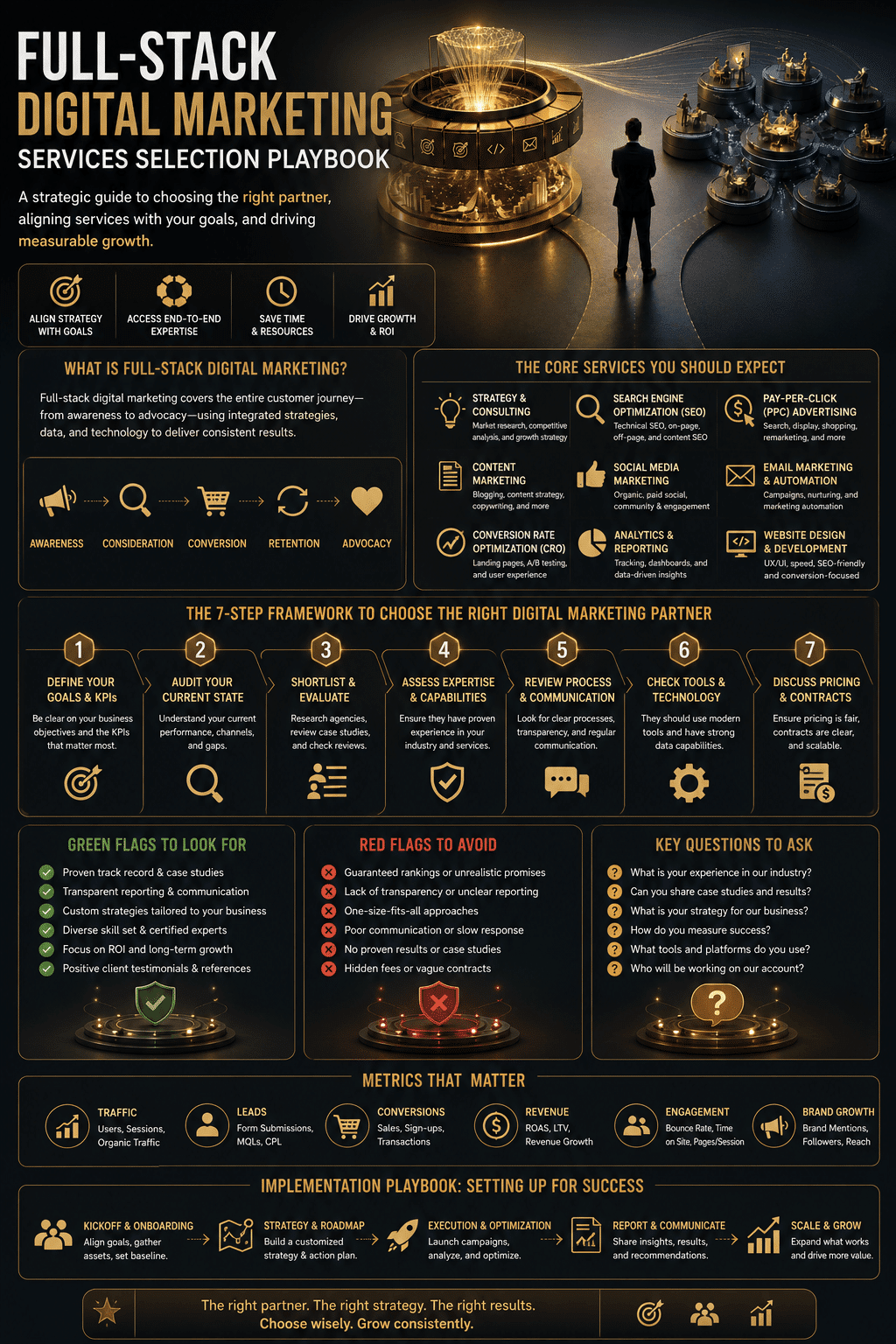
The post Full-Stack Digital Marketing Services: Selection Playbook appeared first on Visualmodo.





0 Commentaires