Quick Answer
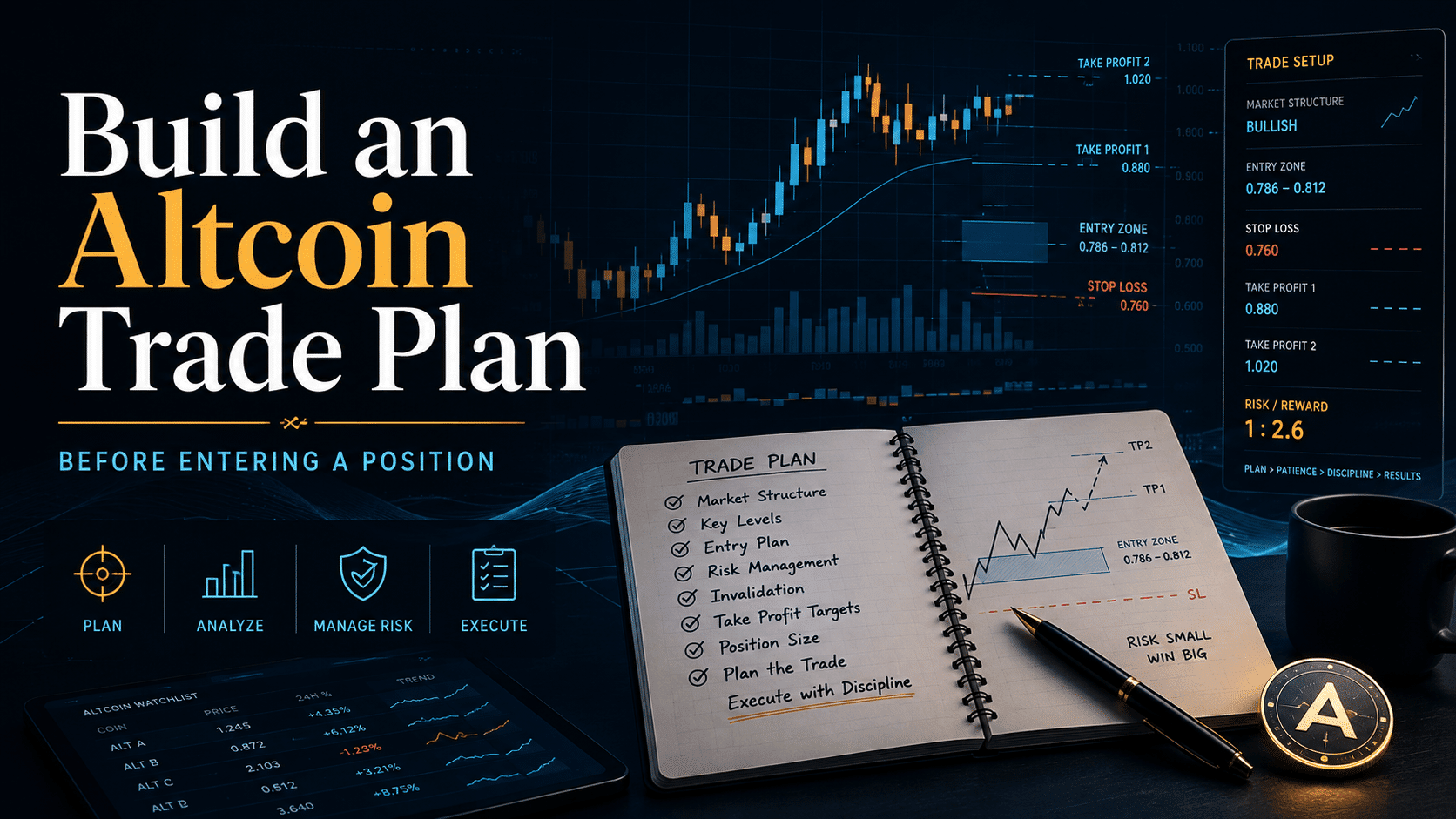
A complete altcoin trade plan defines the trade thesis, entry trigger, invalidation level, position size, profit targets, execution method, and post-entry management rules before an order is submitted. A trader should not enter when any of these elements is unclear, because the missing decision will otherwise be made under emotional or volatile market conditions.
Key Takeaways
- A trade idea is not a trade plan, a plan turns an opinion into a set of conditional decisions.
- Position size should come from account risk, not conviction in the idea.
- Liquidity has to be checked at the order level, not estimated from headline volume.
- Stops belong where the thesis is proven wrong, not at an arbitrary percentage.
- The plan should specify how the position will be managed after entry, not just how it starts.
Identifying a promising altcoin is not the same as identifying a tradable setup. A plan converts a market opinion into a series of conditional decisions: What must happen before entry? What would prove the idea wrong? How much can be lost? How will the position be exited? This guide lays out a repeatable framework, it is not a trade signal, and it does not predict the outcome of any specific setup.
What Should an Altcoin Trade Thesis Include?
Use a testable thesis: Define the asset, setup, catalyst, time horizon, and confirmation condition.
Separate watching from entering: A catalyst puts a token on your watchlist; an entry requires confirmed price, volume, or market-structure signals.
Define the failure condition: Decide upfront what would invalidate the thesis, such as a failed breakout, lost support, negative fundamental change, or broader market weakness.
How Do Traders Validate an Altcoin Setup Before Entering?
Apply a broader market-regime filter
Before evaluating any single token, check the environment it trades in: Bitcoin’s trend and proximity to major support or resistance, BTC dominance and whether capital is rotating toward or away from altcoins, breadth across altcoins rather than one isolated token, and overall volatility relative to the crypto-event calendar. Also confirm the planned holding period doesn’t overlap with a major scheduled announcement.
As a dated snapshot rather than an evergreen claim: on August 6, 2026, CoinGecko showed total crypto market capitalization near $2.29 trillion, with BTC dominance around 56.7%. Both figures move constantly and should be rechecked immediately before any decision.
Review token-specific supply and event risks
A short due-diligence checklist should cover circulating supply versus total supply and fully diluted valuation (FDV), upcoming unlocks or emissions, holder concentration, treasury or team-controlled allocations, the contract address and supported network, any security incidents, migrations, or bridge dependencies, and whether recent activity is driven mainly by a listing or a temporary campaign rather than organic demand.
A small-cap risk example
At the time of research, CoinGecko reported roughly 14.35 million TRADOOR tokens in circulation against a 60 million total supply, an $8.1 million market cap, an FDV near $34 million, and about $1.8 million in tracked 24-hour volume. That gap between market cap and FDV implies meaningful future dilution, and the low volume figure signals limited liquidity. These numbers are illustrative of the type of risk small-cap tokens carry, they need to be rechecked against a live source before acting on them, since supply and volume data can differ across providers.
How Can Traders Evaluate Altcoin Liquidity?
Headline 24-hour volume alone is a weak liquidity signal. Also check the bid-ask spread, order-book depth near your entry, estimated price impact for your order size, recent trading activity, volume distribution across exchanges, withdrawal status, and signs of artificial trading.
A practical depth test is to measure liquidity within 0.5% and 1% of the current price, estimate your average fill price, reduce position size if it would consume too much visible liquidity, and base risk calculations on the estimated fill price rather than the last traded price.
| Venue type | Advantages | Risks |
| Centralized exchange (CEX) | Order book depth, advanced order types | Custody risk, outage risk, withdrawal and jurisdictional restrictions |
| Decentralized exchange (DEX) | Self-custody, on-chain transparency | Price impact, MEV, smart-contract and bridge risk |
How Should an Altcoin Trade Entry and Exit Be Planned?
The entry should be based on an observable trigger, such as a breakout and retest, reclaim of a key level, higher low at support, or a range breakout with rising volume, not vague signals like “strong momentum.”
The stop should reflect market structure, volatility, liquidity sweeps, and the trade’s time frame rather than an arbitrary percentage.
Profit targets can be based on prior highs, range boundaries, high-volume zones, or measured moves, with exits planned in advance through a single target, partial profit-taking, or a trailing position.
| Component | Required decision | Reject the trade when |
| Entry | Exact trigger and acceptable fill range | Price moves without confirmation |
| Invalidation | Level or event that disproves the thesis | No objective invalidation exists |
| Stop | Order type and expected slippage | Loss exceeds the risk budget |
| Targets | Predefined exit levels | Upside does not justify downside |
| Time horizon | Expected setup duration | Capital may be trapped indefinitely |
How Much Should a Trader Risk on an Altcoin Trade?
Position size should be based on account risk, not conviction. Calculate maximum loss = account equity × risk percentage, then position size = maximum loss ÷ effective risk per token, where effective risk includes the entry-to-stop distance, estimated slippage, and fees.
For example, a $10,000 account risking 0.75% ($75), with an entry at $0.57 and stop at $0.52, has $0.05 risk per token, giving a theoretical size of 1,500 tokens before adjusting for fees, slippage, and available liquidity. A wider stop should always mean a smaller position.
At the portfolio level, combine risk across correlated positions, cap total portfolio exposure, reduce size for illiquid or uncertain assets, and never increase position size to recover previous losses.
Should Traders Use Spot, Perpetuals, Limit Orders, or Market Orders?
Spot trading
Spot trading means direct ownership of the token, with no liquidation price and no recurring funding payment, but full downside exposure and, on centralized venues, custody risk.
Perpetual contracts
Offer capital efficiency, short exposure, and hedging flexibility, but introduce liquidation, funding costs, mark-price mechanics, and basis differences that can amplify losses. The U.S. Commodity Futures Trading Commission specifically warns that leverage magnifies the underlying risk of virtual-currency trading. Given that, the worked position-sizing example above is spot-based; a leveraged version would need a separate liquidation and funding model.
| Order type | Priority | Trade-off |
| Limit order | Price control | May remain unfilled |
| Market order | Execution certainty | Uncertain final price, possible slippage |
| Stop-market | Exit after trigger | May fill well below the stop in a fast move |
| Stop-limit | Minimum acceptable price | May fail to execute during a rapid decline |
Traders can open the live market to trade TRADOOR/USDT, but should first inspect the pair’s spread, depth, supported order types, fees, and withdrawal status rather than treating exchange availability as evidence that the setup is liquid or suitable. As one example of an execution screen, MEXC currently documents limit, market, take-profit/stop-loss, OCO, and trailing-stop order types for spot trading, availability, fees, and supported pairs can change, and this is not an endorsement of any specific venue.
How Should an Altcoin Position Be Managed After Entry?
The stop should move only after a predefined structural or profit condition, not automatically to breakeven after a minor favorable move, and the plan should state up front whether it can only tighten or whether volatility-based adjustments are allowed. For partial exits, specify the percentage sold at each target, whether remaining exposure uses a fixed or trailing stop, and require a separate confirmation signal before adding to a position, recalculating total risk each time.
Time and event-based exits matter too. It’s worth reassessing when the setup hasn’t progressed within the planned period, the expected catalyst has passed, volume disappears, the broader market regime changes, or new tokenomics, security, or regulatory information undermines the thesis. Contingency rules should also cover partial fills, exchange outages, withdrawal suspensions, or a price gap through the stop.
Decision Framework: Final Go/No-Go Checklist
Before placing an order, confirm each of the following:
- The thesis can be stated in one sentence.
- The entry requires an objective trigger.
- The exact invalidation condition is known.
- The stop reflects structure and volatility, not a round number.
- Position size is based on maximum account risk.
- Fees and realistic slippage are included in the sizing math.
- The pair has sufficient spread and depth for the order size.
- Token unlocks and market events have been checked.
- Profit-taking and management rules are written down.
- The order type and contingency plan match the venue.
A “no” answer on invalidation, liquidity, position size, or exit execution means the trade is automatically skipped, regardless of how compelling the thesis looks.
Conclusion
A complete plan doesn’t make an altcoin trade safe or guaranteed to be profitable, nothing does. Its purpose is narrower: to define acceptable conditions in advance, cap the loss if the idea is wrong, and remove impulsive decisions from a volatile market. When the market doesn’t meet the written conditions, passing on the trade is successful execution, not a missed opportunity.
FAQ
Seven core components: a one-sentence thesis, an entry trigger, an invalidation level, a stop, a position size, profit targets, and management rules.
Seven core components: a one-sentence thesis, an entry trigger, an invalidation level, a stop, a position size, profit targets, and management rules.
No. The invalidation level should come from market structure and volatility first; the resulting price distance is what determines position size, not the other way around.
Not necessarily. Limit orders offer price control but no guarantee of a fill, while market orders guarantee execution but expose the trader to slippage, the better choice depends on whether price certainty or fill certainty matters more for that specific trade.
When the original entry trigger, time window, liquidity conditions, or underlying market thesis no longer holds.
The post How to Build a Complete Altcoin Trade Plan Before Entering a Position appeared first on Visualmodo.





0 Commentaires